
Explanation
How changes stay deliberate
Compare before changing
Section titled “Compare before changing”FilterHelm starts with read-only comparisons. Drift shows managed entries that are missing or conflicting across reachable instances. An instance that fails a read is reported as an error and excluded from the comparison. You need at least two reachable instances for a comparison.
Drift does not reconcile entries. Its Fix in links open the pages that own them. You choose the entry and review the change there. Returning to Drift reloads the comparison; refresh is explicit.
Read more about row navigation.
Confirm one instance at a time
Section titled “Confirm one instance at a time”You see what will change before you confirm a write. Changes add or remove the entries that differ instead of replacing whole record sets. An action aimed at several instances runs on each instance in turn and reports each result.
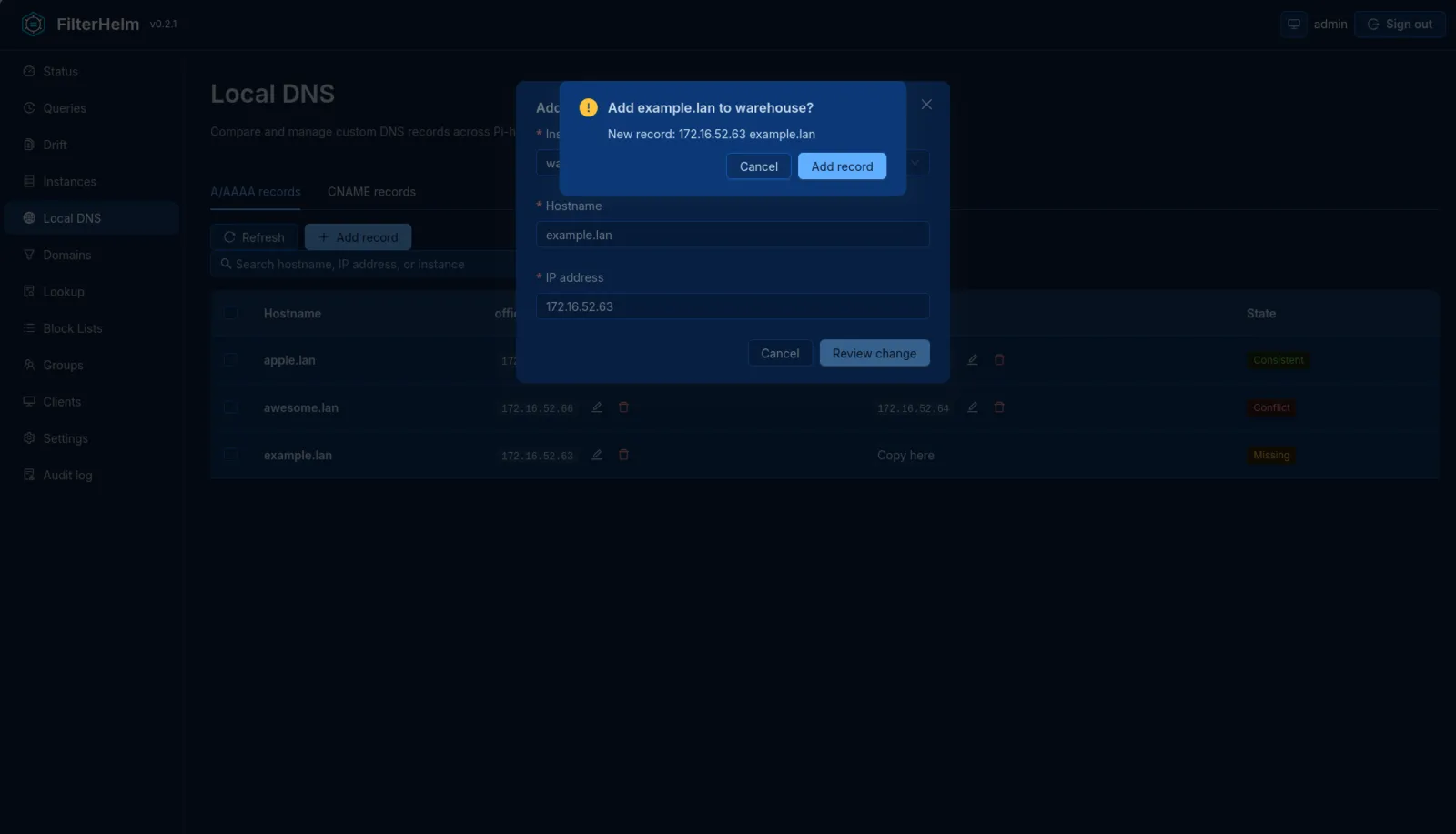
Sequential changes reduce the chance of taking every resolver down together. They do not make several instances a transaction. Some instances can succeed while another fails. Check the reported results before deciding what to do next.
Read more about the safety rules.
Gravity is a separate action
Section titled “Gravity is a separate action”Adding, copying, enabling, disabling, or removing a block list does not run gravity. A real list change marks that instance as pending. You then choose and confirm Update gravity. A failed update leaves the instance pending so you can retry.
FilterHelm has no background scheduler, startup mutation, or timer that reconciles instances. It does not run gravity or restart FTL without an explicit, confirmed action.
Keep a record and keep backups
Section titled “Keep a record and keep backups”The audit log records sign-ins and configuration changes, along with backup downloads and service actions. You can inspect it from the Audit log page. It contains operational details such as usernames, addresses, DNS names, and changed setting values. Passwords and session tokens are excluded.
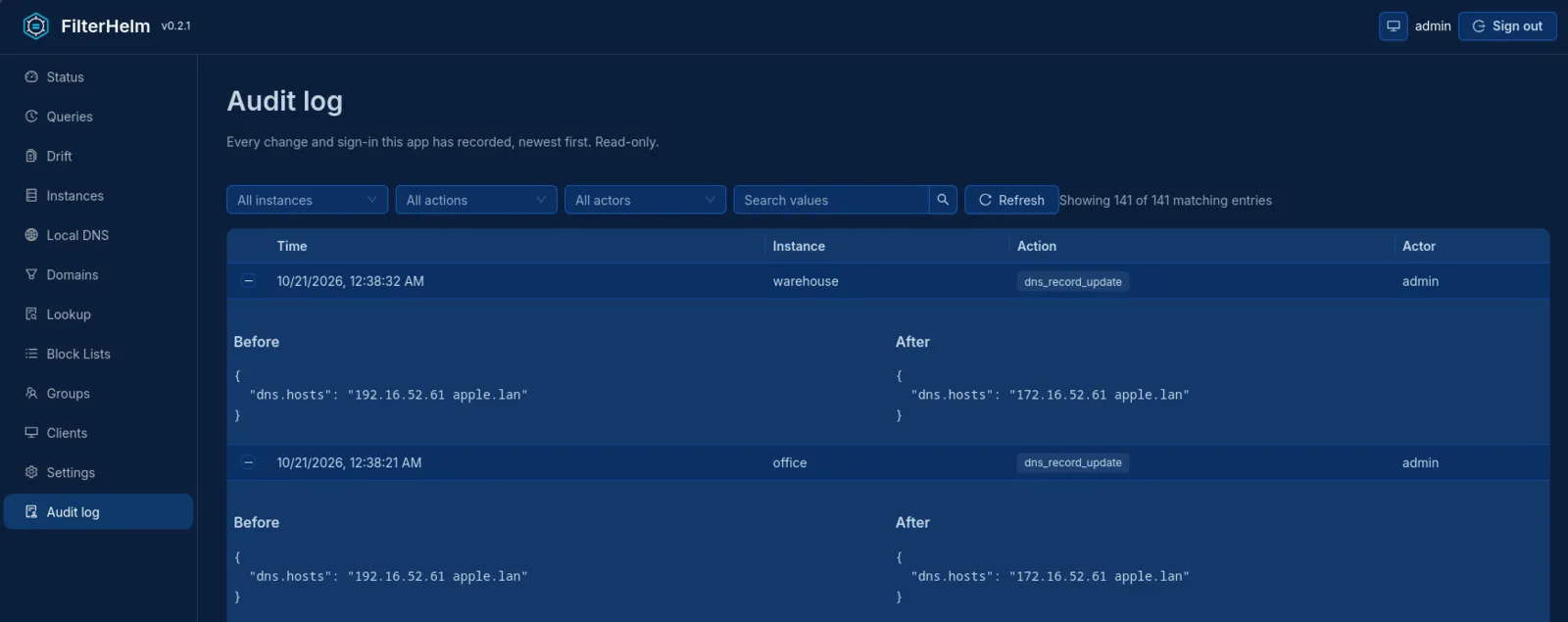
The audit log is a record, not a backup or an undo operation. Protect the data directory and its backups. On hosts without a keyring, stored Pi-hole passwords are not encrypted. DNS filtering and confirmation dialogs are not security guarantees.